Free Website Project Brief Template
Plan your website project properly before you speak to any agency. This practical template helps Irish business owners clarify their vision, requirements, and expectations — so you get exactly what you need.
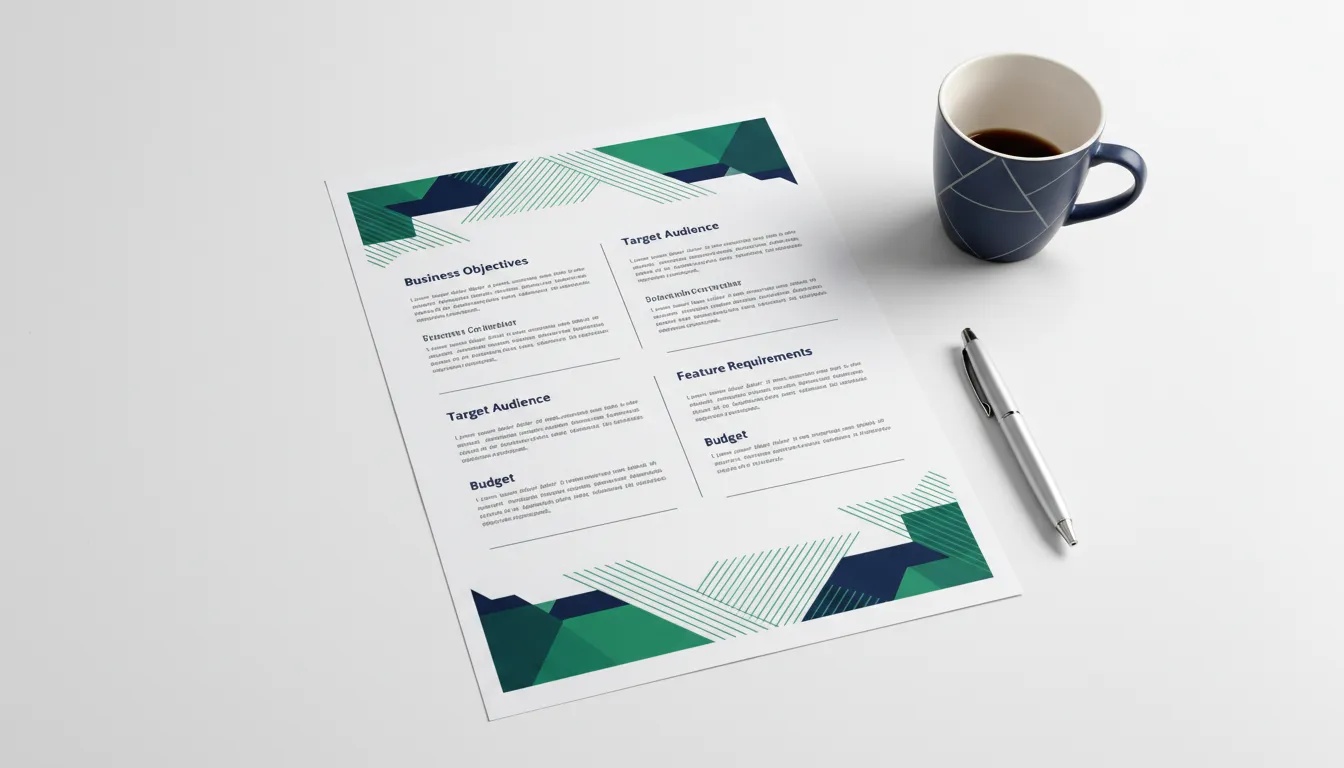
What's Inside the Template
Everything you need to communicate your vision clearly to web design agencies
✓ Business Objectives & Goals Section
Define what success looks like for your website project
✓ Target Audience Definition Framework
Map out who you're trying to reach and why
✓ Feature Requirements Checklist
Specify exactly which features and functionality you need
✓ Design Preferences Guide
Communicate your aesthetic vision and brand guidelines
✓ Content Planning Matrix
Organise and plan all the content your site needs
✓ Budget & Timeline Expectations
Set realistic expectations around cost and project duration
✓ Technical Requirements Overview
Document any specific technical needs or integrations
✓ SEO & Marketing Goals
Outline your search visibility and online marketing targets
✓ Competitor Analysis Template
Review what your competitors are doing well (and not)
✓ Agency Evaluation Criteria
Use a scorecard to compare and select the right agency
Why You Need a Project Brief
Going to an agency without a clear brief leads to costly problems
Without a Brief
- • Scope creep and budget overruns
- • Miscommunication about expectations
- • Wasted time on revisions
- • Website that doesn't serve your business goals
- • Difficulty evaluating competing quotes fairly
With a Clear Brief
- • Everyone understands project goals from day one
- • Accurate quotes and realistic timelines
- • Fewer revisions and changes
- • Website that actually drives business results
- • Better partnership with your chosen agency
Download Your Free Template
No sign-up required. Just click and download the PDF — it's yours to keep and use with any agency.
Get a Free Quote & Brief TemplateRequest a quote and we'll include the brief template with your consultation pack.
From the Team Behind 1,000+ Irish Websites
This template was created by ProfileTree, drawing on 15+ years of experience working with Irish businesses across every sector and county. We know what agencies need to see — because we've been on both sides of the table.
How to write a website brief: a step-by-step guide
A website brief is the single most important document in any web design project. It is the bridge between what you have in your head and what an agency actually builds. Get it right, and the project runs smoother, costs less, and delivers a website that actually works for your business. Get it wrong — or skip it entirely — and you are essentially asking someone to build your house without an architect's drawing.
The good news is that writing a brief does not require any technical knowledge. You do not need to know HTML, understand hosting, or have opinions about JavaScript frameworks. What you need is clarity about your business, your customers, and what you want the website to achieve. Our template walks you through each section, but here is a practical walkthrough of how to approach each part.
1. Start with your business objectives
Before thinking about colours, layouts, or features, write down why you need a new website. Are you trying to generate leads? Sell products online? Reduce the number of phone calls from people asking basic questions? Establish credibility in a new market? Your objectives shape every decision that follows. If you cannot articulate what the website needs to do for your business, the agency cannot build something that does it. Be specific — "generate 20 qualified leads per month" is far more useful than "get more customers."
2. Define your target audience
Who are the people you want visiting this website? Think about their age, location, job role, and the problems they are trying to solve. An accountancy firm targeting owner-managed businesses in Munster needs a very different website from a tourism experience targeting American visitors to the Wild Atlantic Way. The more specific you can be about your audience, the better the agency can design a user experience that speaks to them. Include details like how tech-savvy your audience is, whether they primarily use mobile or desktop, and what competing websites they might be comparing you against.
3. List your must-have features
Separate your features into "must have" and "nice to have." Must-haves are things the site cannot launch without — a contact form, a blog, e-commerce functionality, booking integration, multilingual support, or a members area. Nice-to-haves are things you would like but could live without in version one — a customer portal, live chat, an events calendar, or advanced filtering. This distinction helps agencies quote accurately and prioritise development time. It also prevents the scope from quietly expanding mid-project, which is one of the most common causes of budget overruns in website development.
4. Gather your design references
You do not need to be a designer to communicate what you like. Collect three to five websites whose look and feel appeals to you, and make notes about what specifically you like — the clean layout, the use of photography, the colour palette, the way they present pricing. Equally, note anything you actively dislike. These references give the design team a starting point that is far more useful than abstract descriptions like "modern" or "professional." Also include your brand guidelines if you have them: logo files, colour codes, font preferences, and tone of voice.
5. Plan your content
Content is where most website projects stall. The design is approved, the development is underway, and then everything grinds to a halt because the copy has not been written. In your brief, list every page you need (homepage, about, services, contact, blog, etc.) and note whether you will provide the content yourself, need the agency to write it, or want to use your existing content. If you need help with content creation, say so upfront — it significantly affects the quote and timeline.
6. Set your budget and timeline
Many business owners are reluctant to share their budget, worrying the agency will simply fill it. But withholding your budget actually makes things harder — the agency cannot recommend the right approach without knowing your constraints. A €3,000 budget calls for a very different solution than a €30,000 one. Be honest about what you can invest, and any good agency will tailor their recommendation accordingly. Similarly, be clear about your timeline. If you need the site live before a trade show, product launch, or seasonal peak, say so. Check our website cost guide for realistic pricing benchmarks.
7. Document your technical requirements
This is where you note any specific technical needs: integrations with existing systems (CRM, accounting software, booking platforms), e-commerce requirements (payment gateways, shipping calculations, stock management), GDPR compliance needs, accessibility standards, or preferred platforms. If you have a strong preference for WordPress or another CMS, include that. If you need the site to integrate with specific tools like Mailchimp, Xero, or a property management system, list them here.
8. Define your SEO and marketing goals
A beautiful website that nobody can find is an expensive brochure. In your brief, outline what you want to achieve from an SEO perspective: the keywords you want to rank for, the geographic areas you are targeting, whether you need local SEO or national coverage, and any existing search positions you want to protect during the migration. Also note whether you need ongoing SEO support after launch or just want the site built with best practices from day one.
Common website brief mistakes to avoid
After reviewing hundreds of website briefs over 15 years, here are the mistakes we see most often — and how to avoid them.
Being vague about objectives
"We want a modern website" tells an agency nothing about what the site needs to achieve. Instead, define measurable goals: "We want to generate 30 enquiries per month through the contact form" or "We need to sell 200 units per month through the online shop." Specificity is everything.
Forgetting about mobile
Over 60% of web traffic in Ireland comes from mobile devices. Your brief should explicitly address the mobile experience: what should the navigation look like on a phone? Are there features that work differently on mobile? Should click-to-call be prominent? Do not assume "responsive design" covers it — spell out what matters on smaller screens.
Ignoring content until later
The number one cause of delayed website launches is content not being ready. If you leave content planning until after the design is approved, you will end up rushing it, and rushed content means weak SEO, unclear messaging, and pages that do not convert. Plan your content strategy in the brief, even if the exact copy comes later.
Not mentioning existing systems
If your business uses specific software — a CRM, accounting package, booking system, or stock management tool — the new website may need to integrate with it. Failing to mention this in the brief can lead to nasty surprises mid-project when the agency discovers they need to build a custom integration that was not in the quote.
Design by committee
Having seven people approve every design decision is a recipe for a website that satisfies nobody. In your brief, clarify who the decision-makers are and what the approval process looks like. Ideally, one person has final say on design and content. The more people involved in subjective decisions, the longer the project takes and the blander the result.
No post-launch plan
Your website does not end at launch — that is when the real work begins. Include in your brief what happens after go-live: who will update content? Do you need training? Will you need ongoing SEO services? What about hosting, security updates, and backups? Thinking about this upfront means you will not be scrambling to figure it out on launch day.
What good agencies look for in a brief
We receive website briefs every week, and the quality varies enormously. The best briefs — the ones that lead to the best projects — share certain characteristics. They do not need to be long or use technical language. What they need is clarity.
A good agency wants to understand your business context: what you sell, who buys it, how you are different from competitors, and where the website fits into your sales process. They want to know what is not working about your current site (if you have one) and what specific outcomes you are hoping the new site will deliver. They want honest information about your budget so they can recommend the right approach rather than gold-plating a simple project or cutting corners on a complex one.
The brief does not need to dictate design decisions. You do not need to specify that the hero section should be 600 pixels tall with a parallax background. That is the agency's expertise. What you should communicate is the impression you want visitors to get: "We want to look established and trustworthy, not flashy" or "We need to feel approachable and friendly, not corporate." These kinds of direction are genuinely useful and give the design team creative freedom within clear boundaries.
Perhaps most importantly, a good brief is honest about what you do not know. If you are unsure whether you need e-commerce or whether a simple enquiry form would work better, say so. If you do not know what CMS you want, say that too. A professional agency would far rather help you work through these decisions than receive a brief full of technical requirements that have been copied from someone else's project and do not actually fit your needs.
Tailoring your brief to your website type
Different types of websites have different requirements. Here is what to emphasise depending on what you are building.
Brochure & Corporate Sites
Focus on brand positioning, messaging hierarchy, and the user journey from landing page to contact. Clarify how many pages you need, what your key messages are for each audience segment, and how leads will be captured. Include details about photography and whether you need a professional shoot or will use existing assets.
E-commerce Websites
Emphasise product catalogue size, payment methods (Stripe, PayPal, bank transfer), shipping zones and calculations, tax handling (particularly VAT for cross-border EU sales), returns policy, and inventory management. Note whether you need product variants (sizes, colours), filters, customer accounts, and email marketing integration.
Service-Based Business Sites
Detail each service you offer, how customers typically find you, and what the conversion path looks like (phone call, form submission, booking). Include your geographic service area and whether you need location-specific pages. If you rely on local SEO, flag that in the brief so the site architecture supports it.
Membership & Portal Sites
Outline the different user roles and what each can access. Define the registration process, content gating requirements, payment and subscription handling, and any community features (forums, messaging, events). These sites are technically complex, so the more detail you provide, the more accurate the quote will be.
Tourism & Hospitality Sites
Highlight the booking or reservation system requirements, seasonal content needs, gallery and video requirements, multilingual support (especially for international visitors), Google Maps integration, and third-party platform connections (Booking.com, TripAdvisor, Fáilte Ireland). Visual impact is typically critical here.
Blog & Content-Led Sites
Focus on content organisation (categories, tags, series), author management, content marketing workflow, email capture and newsletter integration, social sharing, and SEO requirements. Specify your expected publishing frequency and whether you need features like related posts, reading time estimates, or content upgrades.
Website planning considerations for Irish businesses
There are several factors specific to the Irish market that your website brief should address. GDPR compliance is non-negotiable — your site needs a proper cookie consent mechanism, a privacy policy that meets the requirements set by the Data Protection Commission, and clear data processing procedures. If you collect customer data through forms, the brief should specify how that data is stored, who has access, and how long it is retained.
If your business operates across the border — serving customers in both the Republic of Ireland and Northern Ireland — your brief should address currency display (Euro, Sterling, or both), delivery zones and pricing, and any differences in regulation or compliance requirements. This is particularly relevant for e-commerce businesses and service providers operating on an all-island basis.
For businesses targeting specific regions, location-specific content and landing pages should be part of the brief. A plumber in Cork needs different SEO-optimised pages than one in Dublin, and the site architecture should support this from day one rather than trying to bolt it on later. Our local SEO services can help with this strategy.
Finally, consider government funding. Irish businesses may be eligible for the LEO Trading Online Voucher (up to €2,500 towards your website), Enterprise Ireland funding, or InterTradeIreland grants for cross-border trade. If you plan to apply for funding, mention this in your brief — some grant programmes have specific requirements around quotes, timelines, and deliverables that the agency needs to accommodate.
Frequently Asked Questions
Is the template really free? ▼
Yes, completely free. No hidden costs, no credit card required. We created this template because we have seen too many website projects go wrong due to unclear briefs. When businesses approach agencies with well-written briefs, the entire industry benefits — projects run smoother, results are better, and both sides are happier.
How long does it take to complete the brief? ▼
Most businesses complete it in one to two hours. You do not need to do it in one sitting — work through it section by section at your own pace. Some sections (like gathering design references or listing technical requirements) might require input from other people in your organisation, so allow a few days for that. The time you invest now will save you many more hours during the project itself.
Can I use this brief with any web design agency? ▼
Absolutely. This template uses industry-standard language and structure that any professional web design agency will understand and appreciate receiving. In fact, the quality of your brief often determines the quality of the proposals you receive. Agencies invest more thought into responding to well-prepared briefs because it signals a serious, organised client they want to work with.
What if I don't know the answers to some questions? ▼
That is perfectly fine — and very common. The template includes guidance notes for every section to help you think through each area. Part of the value of writing a brief is that it surfaces the questions you had not considered yet. If you genuinely cannot answer a section, leave a note saying "Need guidance on this" — any good agency will appreciate the honesty and help you work through it during the discovery phase.
How detailed should the budget section be? ▼
Be as honest as you can. If you have a fixed budget of €10,000, say so. If you have a range of €5,000 to €15,000 depending on what is possible, share that range. Withholding budget information does not protect you — it just means the agency has to guess, and they might propose something far above or below what you had in mind. For realistic pricing benchmarks, check our website cost guide for Ireland.
Should I send the brief to multiple agencies? ▼
We recommend sending your brief to three to five agencies. This gives you enough variety in approaches and pricing to make an informed decision without the process becoming unmanageable. Our template includes an agency evaluation scorecard that helps you compare proposals on a level playing field — covering things like relevant experience, proposed approach, timeline, communication style, and value for money.
What should I include about SEO in my brief? ▼
At minimum, include the keywords or topics you want to rank for, the geographic area you are targeting, and whether you need ongoing SEO services after launch. If you have an existing website with search rankings, mention that — any competent agency will need to plan redirects to protect your existing positions during migration. If you are starting fresh, note your main competitors and the search terms you want to target.
Can I update the brief after sending it to agencies? ▼
Yes, and you should expect to. The brief is a starting point, not a contract. Most agencies will come back with questions and suggestions that help refine the brief further. The discovery and scoping phase exists precisely for this purpose. A good agency will help you sharpen your requirements, identify things you had not considered, and sometimes suggest simpler solutions to problems you were overcomplicating.
Related Resources
Explore more guides to help you plan your website project
How Much Does a Website Cost in Ireland?
Understand realistic pricing for different website types and complexity levels.
Read Guide →WordPress Development Ireland
Custom WordPress websites built for performance, security, and growth.
Learn More →SEO Services Ireland
Make sure your new website is built to rank from day one.
Learn More →